CORNISH DAIRY HERD TAKES TOP HONOUR IN 2025 NMR RABDF GOLD CUP

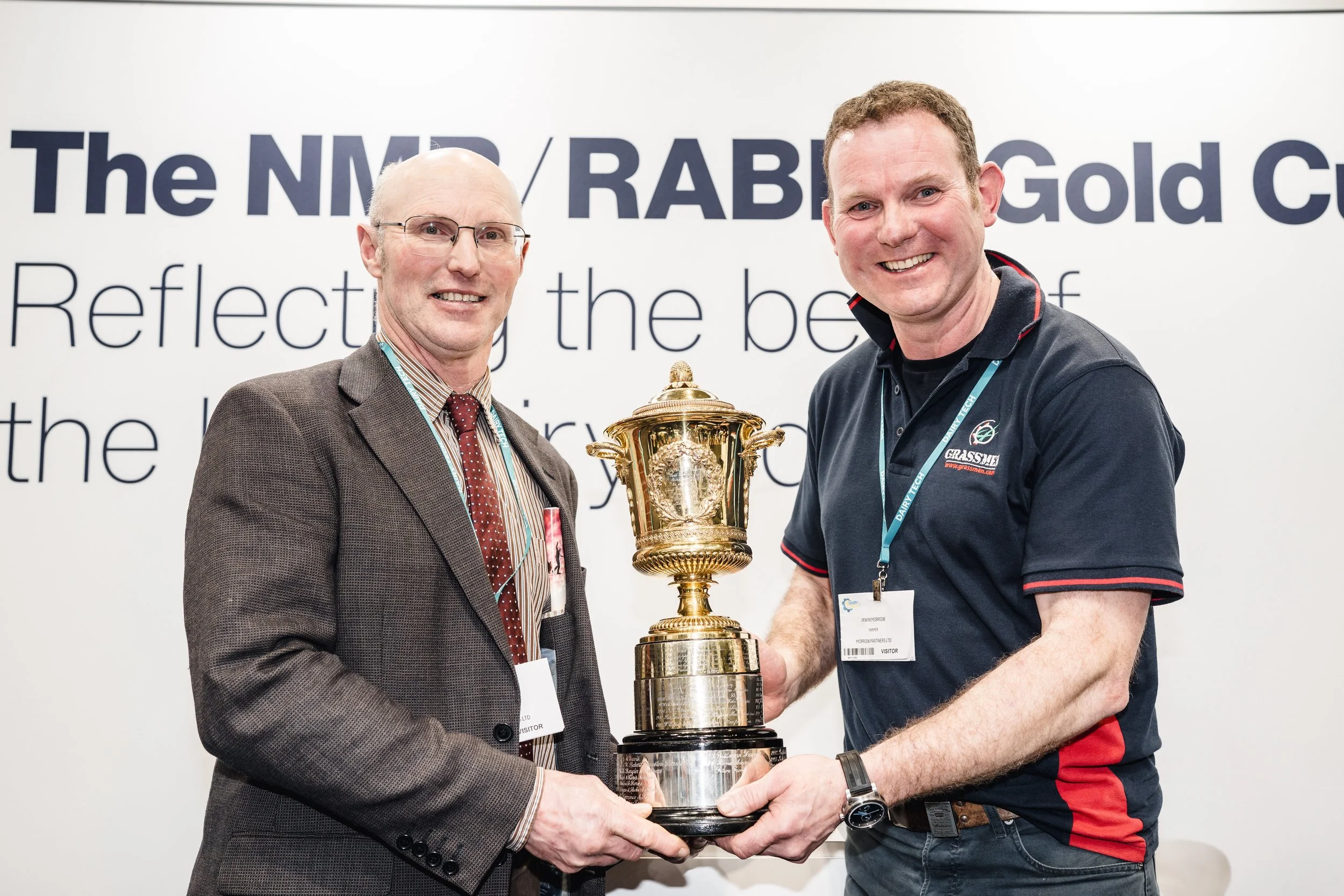
A Cornish dairy business, based near Truro, has been named the winner of the 2025 NMR RABDF Gold Cup.  Paul Broad of T N Morrow and Partners, Treveale Farm, Ladock, was presented with this top industry award at Dairy-Tech, Stoneleigh, today, February 4, 2026.

This family-run dairy farm of Paul Broad and his wife, Wendy (née Morrow), together with Wendy’s brother, Irwin Morrow, and Paul and Wendy’s sons, David and Philip, carry out all roles on the farm, from milking cows and rearing calves to planting and harvesting forages.

The family has made considerable investments in the past decade for the next generation, with a new dairy unit in 2018 and a new youngstock unit in 2023.

The pedigree Maymor Holstein herd has doubled in cow numbers in the past 14 years, to the current 471 milking cows and 461 youngstock followers, on the 280-hectare unit.

Average annual milk yield is 12,362kg, at 4.26% fat and 3.44% protein, with 33% of the milk produced from home grown forage.

Milk quality is closely monitored, with the latest results showing a somatic cell count of 112,000/ml and a Bactoscan of 10. The herd is BVD-free and its Johne’s average test value (ATV) of 2.5, from routine milk screening, indicates exceptionally low infection rates.

Breeding high genetic merit animals with type traits that favour longevity and rearing fit, healthy heifers are major contributors to their business efficiency. They also focus on improving soil health, reducing fertiliser use, while improving forage quality and milk from forage, and using fewer antibiotics to future-proof the business.

A second highly prestigious award, The Chris May Memorial Award, made to the Gold Cup qualifying herd with the highest lifetime daily yield (LDY), was awarded to Messrs Harvey from Drum Farm in Dumfries.

Their Killywhan Holstein herd of 278 cows and 140 followers is run by John and brother Stuart. The herd achieved an average lifetime daily yield of 23kg/cow/day.

Average production is 14,800kg/cow at 4.13% butterfat and 3.5% protein. A total of 18 cows in the herd have produced over 100 tonnes of milk in their lifetime so far. 

Longevity is important in this herd and 30% of the herd – 80 cows – are in their 5th or greater lactation and 11 animals are 8th or 9th lactation cows, with the average number of lactations being 3.41.

While the breeding policy is important, getting nutrition right so that cows can reach their potential is more important in achieving all-round efficiency.

Three more awards were presented to herds with the highest combined fat and protein (CFP) within their breeds.

The NMR Silver Salver, for the herd with the highest CFP, was won by R Torrance and Son from Stapleford Abbotts, near Romford, Essex

The Torrance’s Curtismill pedigree Holstein herd of 730 cows with 560 followers achieved a top CFP of 1,076kg for the year ending September 2024.

Milk sold averages 14,892kg per cow at 4% butterfat and 3.33% protein. They achieve these high levels of performance and constituent milk values through good breeding plans and attention to detail in herd management

The Lilyhill Cup, presented to the Jersey herd with the highest CFP was won by the Hunter family from Shotts, Lanarkshire.

Their Clydevalley Jersey herd, comprising 200 cows and 200 followers, is run by Robert and Lorraine Hunter in partnership with their son Mark.

The herd’s CFP for the year ending September 2024 was 846kg, placing them top of the breed among qualifying herds, and the current average production is 8,023kg of milk at 6.27% butterfat and 4.09% protein on twice a day milking. Milk is sold to Graham’s.

Key to achieving high butterfat in this herd is feeding high dry matter silage, which is cut and baled in-house, giving them full control of its production.

Winner of the Chairman's Cup, for the herd of a breed other than Holstein or Jersey, with the highest CFP was awarded to the Cowhill Trust Muirside, Dumfries, run by Stuart Neish.

This herd of 210 cows is a blend of Ayrshire and Red and White Holstein. They achieved a CFP of 763kg in the year ending September 2024.  Average milk yield is 11,000kg at 4.2% fat and 3.6% protein

Milk is sold to cheese manufacturer Lactalis, so high protein milk is targeted.

A strong reliance is placed on home grown forages on this farm, with about 90% of the diet home grown. Cows are housed for about six months of the year and graze through the summer with a buffer ration fed to supplement the diet.

Finalists in the 2025 NMR RABDF Gold Cup:


·       Ruth and Stephen Ashley, PJ & PE Ashley & Son, Condover, Shropshire

·       Paul Broad, T N Morrow & Partners, Treveale Farm, Ladock, Truro, Cornwall

·       Ben Foote, J H Foote Farming, Church Lane Farm, Brown Candover, Alresford, Hampshire

·       Michael Madders and Rosie Chandler, M Madders Farming Ltd, Church Farm, Coppenhall, Staffordshire

·       William Mayor, Yeo Valley Farms, Yeo Valley, Blagdon, Bristol


About NMR  -


NMR is the leading agri-tech supplier of management information to the UK dairy supply chain. Through a team of self-employed milk recorders, it collects and tests milk samples for approximately 50% of the UK’s 1.8 million cows. In addition, its laboratories provide payment testing and disease testing services for Britain’s milk processors.

NMR has a joint-venture laboratory in the Republic of Ireland providing similar services to farmers and processors across the whole of Ireland. Another division of the Group is a livestock traceability business, Nordic Star, which services the UK dairy and beef sectors. NMR is part of the AB Agri Limited group of companies.

About RABDF  -

RABDF is the sole UK charity dedicated to the needs of dairy farmers. Established in 1876, it is the only dairy organisation to hold a Royal Patronage. RABDF is the organiser of the Dairy-Tech event.

 

Harper Adams Student Wins Prestigious RABDF Dairy Student Award

A Harper Adams University student has been crowned RABDF Dairy Student of the Year 2026, taking home the prestigious award, sponsored by ForFarmers, at Dairy-Tech today (4 February).

Henry Gibson, a BSc (Hons) Agriculture student from Honiton, Devon, was named the 2026 winner after competing against five other finalists in a closely fought contest.

The rigorous judging process included completing a detailed case study appraisal prepared by Kite, part of the Asterra Group, followed by a presentation to an expert judging panel at the Farmers’ Club in London. Finalists were asked to set out their vision for where the dairy industry will be in 10 years’ time, identifying key challenges, opportunities and future scale.

This marks the 11th time in the past 12 years that a Harper Adams University student has secured the award. Henry was presented with a £750 cheque and trophy at the event.

Runner-up, in what judges described as a very close second, was Caitlin Jugg, a fourth-year veterinary student from the University of Surrey.

The competition, run by Dairy-Tech organiser the Royal Association of British Dairy Farmers (RABDF), is designed to highlight challenges faced by the dairy industry while identifying rising stars and future industry leaders.

This year’s judging panel comprised RABDF Chairman Robert Craig, Richard Greasley of ForFarmers, and Kaia Hillsmith from Kite, part of the Asterra Group.

Commenting on the high standard of entries, RABDF Chairman Robert Craig said: “The competition has become highly regarded across the dairy industry due to the calibre of students entering each year. The optimism and enthusiasm shown by applicants is incredibly encouraging for the future of the sector. It was particularly pleasing to see students from a wide range of disciplines, from agriculture to veterinary science.”

Richard Greasley, Technical Manager at ForFarmers, said Henry was a very deserving winner: “His passion and presentation were excellent, and his enthusiasm for the dairy industry going forward was infectious.”

He added that Caitlin Jugg had finished a very close second: “Her presentation style and delivery were very interesting and refreshingly novel. There were only a couple of points between them on my scoresheet.”

The remaining finalists were Freddie Myatt and Ellie McCutcheon (Harper Adams University), Hannah Davis (fourth-year veterinary student, Bristol Veterinary School), and Aimee Gegg (Duchy College).

Mr Greasley said the calibre of entries this year was outstanding. “It is incredibly encouraging to meet such a talented group of young people who are keen to be part of the UK dairy industry. Their enthusiasm was infectious, and I left feeling very positive about the future of the sector being in such capable hands.”

For more news from Dairy-Tech 2026, visit www.dairy-tech.uk.

About RABDF 

RABDF is the sole UK charity dedicated to the needs of dairy farmers. Established in 1876, it is the only dairy organisation to hold a Royal Patronage. RABDF is the organiser of the Dairy-Tech event.

Arkaya Energy Wins Royal Dairy Innovation Award at Dairy-Tech

Arkaya Energy’s Milk Source Heat Pump, a one-stop solution delivering milk cooling, hot water generation and improved energy efficiency, has been crowned the winner of the Royal Dairy Innovation Award at Dairy-Tech 2026, held on 4 February.

The award was judged and announced at the one-day event at Stoneleigh Park, Warwickshire, and is presented to an exhibiting company showcasing a practical product or service that demonstrates the most significant innovation for the future of dairying.

The Milk Source Heat Pump instantly cools milk to 4°C while simultaneously producing hot water up to 90°C for dairy wash-downs. By recovering heat from the milk cooling process, the system can significantly reduce electricity usage, lower carbon footprint and cut energy costs, helping modern dairy businesses save time, energy and money.

Competition judge and RABDF Council Member Tim Downes said Arkaya Energy stood out for the strength of its presentation and the clear, proven benefits of the technology.

“They put across a really strong presentation on energy savings and a genuinely novel technology that simply isn’t available elsewhere. The savings were backed up by independent observations from NFU Energy, and the level of innovation fitted the Innovation Award criteria 100%.”

He added: “The judges were particularly impressed with how the system could be easily installed, delivering savings equivalent to 127 kilowatts per day on a new installation. The scale of the savings, combined with the professionalism and approach, really blew us away.”

The two runners-up for the 2026 Royal Dairy Innovation Award were:

·        EpiHerd from Antler Bio, which helps dairy farmers unlock herd potential by combining gene expression data with practical, actionable insights.

·        CowToilet from Hanskamp, which offers a novel approach to reducing on-farm emissions by separating urine and faeces at source.

Commenting on the finalists, Mr Downes said: “This year’s finalists were a very strong and diverse group and distinguishing between innovations is a real challenge for the judges, but the quality was exceptionally high.”

This year’s judging panel comprised independent judges Tim Downes, Karen Halton (RABDF Council Member), and Anthony and Jane Marsh of HoofCount, winners of last year’s award.

Kumodak Sharma of Arkaya Energy received a signed and framed certificate at the event and will be presented with the Royal Dairy Innovation Award trophy by HRH The Princess Royal later this year.

For more information on Dairy Tech, visit dairy-tech.uk/

RABDF seeks progressive volunteers to help guide the charity’s work

The Royal Association of British Dairy Farmers (RABDF) is seeking nominations for up to 3 new Trustees to be elected to its Council.

RABDF is the only charitable organisation dedicated to progressing the business of dairy farming and to have the honour of a Royal Patronage.

As a Trustee and Council member, you will help guide RABDF’s strategic direction and governance.

What to Expect

The contribution made by Trustees can transform charities. This role offers the opportunity to help shape the future of RABDF at a crucial time in its 150-year history.

Successful candidates are appointed for an initial three-year term and will be expected to attend up to four Council meetings a year, which will be held in different locations around the UK and online.

Attendance at other RABDF events will be required from time to time.

Trustees are voluntary, non-remunerated positions. A full induction will be provided, along with training and reimbursement of expenses.

Who can apply?

In order to complement the existing range of skills and expertise on the council, RABDF is ideally seeking nominations from those who are active dairy farmers, active in the dairy supply industry, or from those who work in fields that are relevant to the association, including events management and charities.

Previous Trustee or board-level experience, especially in the charity sector, is welcomed but not essential.

RABDF invites nominations from a broad range of candidates both geographically and practically in order to reflect the diversity of the British dairy industry.

Trustees must be members of RABDF at the time of their election.

All nominations must be supported by two RABDF members.

What is the election process?

RABDF members will be asked to vote for and duly elect the names of those to fill the proposed vacancies. Successful trustees will be notified and invited to join RABDF Council from April 2026.

Next steps

Please contact office@rabdf.co.uk or visit our website www.rabdf.co.uk for a nomination form and further information.

Application Form


Closing date for completed nomination forms is Monday 23rd February 2026.

Gold Cup Glory for Harper Adams as Open Day Highlights Positive Future for UK Dairy

Confidence in the dairy sector was evident this week (Wednesday 3 July) as Harper Adams University welcomed over 600 visitors to the 2024 NMR RABDF Gold Cup Open Day.

The event marked the university’s landmark win of the UK’s most prestigious dairy farming accolade—the Gold Cup—celebrating excellence in herd performance, innovation, and sustainability.

Visitors toured the state-of-the-art Future Farm and heard from industry leaders offering technical advice and insight into the future of British dairy.

Opening the day, Deputy Vice-Chancellor Professor Michael Lee called the Gold Cup win “one of the proudest moments of my time at Harper Adams University,” and praised the teamwork and vision behind the achievement.

The upbeat tone was matched by keynote speaker and respected dairy analyst Chris Walkland, who gave his assessment of the market.

 “Lots of milk processors are holding their milk prices for August, so you should be all really positive about the next few months,” he told visitors.

Despite a 4.1% drop in the latest (1 July) Global Dairy Trade (GDT) auction—the steepest decline in a year—Mr Walkland downplayed the impact for UK producers.

“I don’t think this market slide will affect your milk prices,” he said. “It’s a bigger issue for New Zealand. Yes, EU butter prices are down a bit, but cream is flying. It hit £2.85 and rose to £2.90 by the end of last week—that’s exceptional for this time of year.”

“If it weren’t for the insane amount of milk you’re producing, I think we’d be talking about a price rise, not a drop,” he added. “But processors don’t want more milk. They might hold off on increasing the price, just to avoid fuelling production further.”

Looking at farm incomes, Mr Walkland highlighted that May 2025 ranked as the second-highest month on record in terms of milk price multiplied by volume. “March is fourth highest, April seventh, January ninth, and June tenth. The highest month was December 2022. But back then, the money was flying out the window as fast as it came in. Now, hopefully, some of it is sticking to the sides,” he added.

He also reminded farmers of the upcoming Fair Dealing Obligations (Milk) regulation—better known as FDOM—coming into force on 9 July. “If your buyer hasn’t issued a compliant contract by then, technically they’re breaking the law. You’re not—so don’t panic.”

“What it should do is give you more transparency around pricing—and the ability to complain a bit more easily,” he said.

RABDF Chairman Robert Craig, organisers of the prestigious event, said the Future Farm at Harper Adams is a fantastic example of how technology, innovation, and skilled people can work in harmony to improve productivity, health, and sustainability.

“This Gold Cup win is thoroughly deserved, and it’s great to see how academic research and commercial farming can come together to shape the future of our industry.”

Entries and nominations are now open for the 2025 NMR RABDF Gold Cup. The competition is open to all herd management systems, including block calving, grazing, and housed herds. All entrants must demonstrate outstanding herd health, fertility, and business management. More information can be found at https://www.rabdf.co.uk/gold-cup-comp

Students from Harper & Keele, Nottingham and Bridgwater & Taunton are crowned winners in Farm Health Management Award

Students from Harper & Keele Vet School, University of Nottingham and Bridgwater & Taunton College came out on top in the 2025 RABDF Farm Health Management Awards, kindly sponsored by Volac.

The award aims to demonstrate an understanding of, and test students’ knowledge of, proactive farm health management.

The competition is split into three categories: students at agricultural colleges, agricultural universities and vet schools.

Oriana Barnes from the Harper & Keele Vet School, Elektra Brown from University of Nottingham and Amy Bishop from Bridgwater & Taunton College were announced as the winners of the 2025 Farm Health Management Awards.

The runners-up were Catherine Kelly from the University of Surrey, and Beth Wallace from Duchy College.

Each candidate submitted a 1,500 word essay on proactive farm health management explaining how they thought farm sustainability could be enhanced, from both financial and environmental aspects.

The awards were judged by Sarah Banks, and RABDF Trustees Sarah Tomlinson, and Tim Brigstocke. Each category winner took home a £500 cash prize.

Sarah Tomlinson says, again, it was a huge privilege, as a RABDF Trustee, to judge the Farm Health Planning essays.

“All of the entries were clearly passionate about the importance of promoting proactive health policies on farm.”

“The winners stood out with exceptional knowledge of the industry as a whole, noting not only industry professionals, tools and other expertise on and off farm, but also considering the consumer and public perception of farm animal health and welfare. Essays were well substantiated with data from numerous sources, and also supported with the authors own on-farm experiences which really helped bring them to life. It was clear to see they understood the importance of monitoring data and the impact endemic disease can have on costs and long term financial and environmental sustainability of a business.”

The award winners were announced on the Dairy Hub at Dairy-Tech and were presented by Sarah Banks, and Sarah Tomlinson.